Why Point-of-Service Backflow Protection Still Matters
The term containment protection is foundational in the cross-connection control industry and in 2026 it remains just as important as ever.
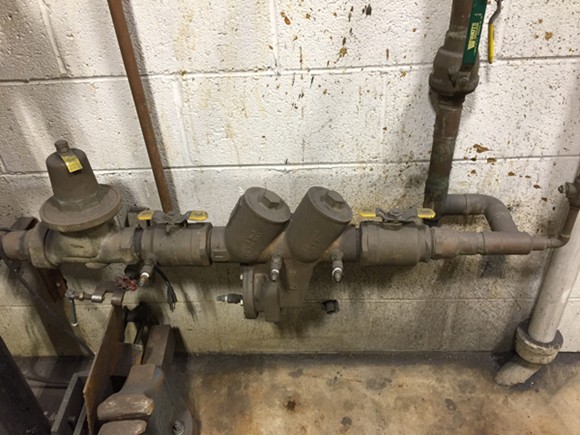
Containment protection, often referred to as point-of-service protection, is the water supplier’s policy of installing backflow protection at the service connection, immediately downstream of the public distribution system and upstream of any branches in the customer’s water system.
Its purpose is clear and specific:
Containment protection protects the public water system from the customer’s plumbing system. It does not protect the occupants inside the building.
Understanding this distinction is critical to designing and enforcing an effective cross-connection control program.
Containment Is Not the Whole Program — It’s One Layer
Containment protection isolates the public distribution system from potential contamination originating within a customer’s facility. In the event of a backflow incident inside the building, containment protection prevents contaminants from being pushed or siphoned back into the public water supply.
However, this also means that containment protection does not dilute or mitigate contamination within the building itself. For that reason, containment protection is not the end goal of a cross-connection control program — it is only one component.
The second, equally important component is a comprehensive isolation protection program, which addresses hazards at fixtures, appliances, and internal systems.
Why Both Isolation and Containment Are Necessary
In theory, if every fixture and appliance in a building were protected perfectly with isolation backflow protection, containment protection would be redundant.
In the real world, that level of perfection does not exist.
- Buildings are modified over time:
- Equipment is added or replaced
- Piping systems are altered
- Temporary connections are made
- Maintenance practices vary
Because these changes cannot always be tracked or controlled, containment protection serves as a critical second line of defense for the public water system.
Cross-Connection Surveys: The Foundation of Good Decisions
The decision about what type of backflow protection is required should never be arbitrary. It must be based on a cross-connection survey.
Isolation Surveys
An isolation survey is a comprehensive evaluation of a facility’s internal water system. It includes:
- All potable water piping and outlets
- Fixtures and appliances
- Drainage connections
- Existing backflow protection
- Identification of actual and potential cross-connections
- Determination of the degree of hazard
The process concludes with a detailed report and follow-up inspections to verify corrections.
Containment Surveys
A containment survey is more focused. It evaluates:
- The degree of hazard associated with the facility as a whole
- The potable water service entrance and meter location
- The suitability of existing containment protection
Based on this assessment, the appropriate method, device, or assembly is selected for installation at the service connection.
How Water Suppliers Approach Containment Protection
Water suppliers vary widely in their containment protection requirements.
Some utilities require:
- Non-testable dual check valves on residential services
- Testable assemblies only on commercial or industrial services
Others require:
- Completed customer self-survey forms
- In-person inspections
- Facility-specific hazard evaluations
While some residential installations may indeed be low hazard, blanket policies that ignore actual water use create risk — especially as residential properties increasingly include:
- Irrigation systems
- Snowmelt systems
- Water reuse systems
- Pools and spas
- Chemical treatment systems
A one-size-fits-all approach does not reflect modern water use.
High-Hazard Facilities Are Not Optional Decisions
Certain facilities are inherently high hazard, regardless of size or occupancy. Examples include:
- Wastewater treatment plants
- Hospitals and healthcare facilities
- Mortuaries
- Plating and manufacturing plants
- Power plants
- Tanneries
- Facilities with auxiliary water supplies or wells
In these cases, reduced pressure principle (RP) assemblies are the appropriate containment protection — and anything less places the public water system at unacceptable risk.
Installation Challenges Must Be Addressed Thoughtfully
Installing containment protection, especially on existing systems, changes hydraulic conditions.
Considerations include:
- Pressure and volume loss
- Creation of a closed water system
- Thermal expansion control
- Minimum residual pressure requirements
- Physical space constraints
- Drainage requirements for relief valve discharge
These factors must be evaluated during design and installation, not after problems occur.
New Construction: A Common Oversight
Containment protection is often not addressed during plan review or permitting because:
- Model plumbing codes focus on isolation protection
- Containment protection is typically governed by water supplier regulations, not plumbing codes
This makes early coordination with the water purveyor essential on all new construction projects.
A practical rule of thumb still applies in 2026:
Containment protection should match the highest degree of hazard within the building.
If a building contains a chemically treated hydronic system that requires an RP for isolation, then the containment protection should also be an RP.
Residential Containment Deserves More Attention
Many jurisdictions do not:
- Track isolation backflow testing in residential properties
- Enforce repair or replacement of failed residential assemblies
This reality reinforces why proper containment protection is necessary on all water services, regardless of building type.
While a non-testable dual check may be appropriate in some residential cases, assuming it is always sufficient without evaluating actual water use puts the public water system at risk.
Prevention Rather Than Cure
Backflow protection is a proactive discipline.
We do not wait for contamination to occur. We:
- Evaluate worst-case scenarios
- Install appropriate protection
- Require testing and maintenance
- Defend our decisions with sound policy
Cross-connection control is not a checklist — it is a risk management program.
As the American Society of Sanitary Engineering states in its long-standing motto: “Prevention Rather Than Cure.”
In 2026, that principle is more relevant than ever.

Sean Cleary
Sean Cleary serves as Vice President of Industry Programs and Operations for the IAPMO Backflow Prevention Institute, advancing education and technical training in cross-connection control and backflow prevention. The IAPMO Backflow Prevention Institute helps to ensure that the professionals responsible for protecting drinking water are properly trained and certified.
A licensed master plumber with more than four decades of experience, Sean has worked in all phases of the plumbing and mechanical industries, with deep expertise in cross-connection control systems. He is a Past President of the American Society of Sanitary Engineering (ASSE) and served for more than a decade as Chairman of the ASSE Cross-Connection Control Technical Committee. A graduate of the United Association Instructor Training Program, Sean has dedicated much of his career to strengthening professional competency, standards alignment, and technical excellence across the industry.
Under Sean’s leadership, the IAPMO Backflow Prevention Institute prepares plumbers, pipe fitters, irrigation techs, sprinkler fitters, HVAC techs, plumbing engineers, inspectors, facility managers to earn and maintain ASSE and other industry certifications through comprehensive training and continuing education offered across the United States and internationally. Sean co-authored the IAPMO Backflow Reference Manual and has contributed to numerous technical publications. Through his work with IAPMO, ASSE, the American Society of Plumbing Engineers (ASPE), and state plumbing inspector organizations, Sean helps ensure that certified professionals are equipped to prevent contamination and safeguard the drinking water systems communities rely on every day.